You bred raptors? Jurassic Park, part 2
Scientists summon Jurassic Park to do two distinct kinds of rhetorical work. Last time on the blog, we talked about how scientists reference the story to make positive claims about the current and future possibilities of science. Today: the sinister inverse. We'll look at how Jurassic Park (JP) is called on to hit the brakes—to flag risks, to keep science within its proper bounds. This wildly popular story of cascading failures has become a shorthand for "this far is too far."
But, as we'll see, not all caution is created equal. Some uses of JP seek to improve or reform current practice by identifying its risks and worst possible outcomes. Others aim to shut down speculation, marking visionary thinking as intrinsically dangerous. The distinction matters because it raises questions about what scientific discourse can do and what purposes it serves.
Both categories, though, counter the awe-struck sense of scientific possibility with a warning: Be careful.
JP is sometimes called on in scientific discourse to make the case for overlooked risks in current practice—to say that science is going too far and needs to be reined in lest the consequences spiral.
This is the case in a 1994 article on software engineering that connects issues in software development directly to the recently released film:
If you saw the movie Jurassic Park, you saw the perfect way not to develop software. The programmer in the movie was the only person who knew the details of the system. No processes were followed, and there was no documentation. This was an absolutely perfect prescription for failure.
The article goes on to lay out practical principles for choosing software vendors which, it explains, will limit the risk of such failures. The way it compares sloppy documentation to the software failure at the heart of JP's collapse is an unexpected touch. In ordinary life, will such negligence lead to catastrophic failure? Maybe, maybe not. But the JP reference drives home the importance of attending to the more-mundane work of systems maintenance—it's a lighthearted way of saying, in effect, "don't be like Nedry."
The same move appears in "Lessons from Jurassic Park: Patients as complex adaptive systems" by David A. Katerndahl (Journal of Evaluation in Clinical Practice 2009). This one is rather wild in its web of allusions, with every section heading bearing a lively quote from the movie. These are mostly lines spoken by Ian Malcolm, the story's chaos theorist and mathematician: the one who prophesied that the park was doomed to fail because it had failed to account for complexity. The Malcolm references dovetail with the article's main argument that medical practitioners are prone to thinking of patients in reductive ways, as determined by "linear, cause-and-effect mechanics." David A. Katerndahl writes that "As in the movie Jurassic Park, it is the non-linearity of life that leads to unpredictability in complex systems." He argues that understanding such dynamics—seeing patients through the lens of chaos theory—is essential to better medical practice. The interspersing of Malcolm quotes* ("Life will find a way," "These are complex organisms. How can you possibly know how the system will react?" and many more) serves the same function as this character in the film and, especially, in the novel: they herald doom** should his warnings not be heeded. In this case, the equation is attend to complexity or patients are doomed.

"It's the butterfly effect," says Malcolm, with David A. Katerndahl (in other words, “I told you so”).
And this example elicits the comparison to JP by means of its parallel ideas of dangerous organisms escaping their containment: "Microbial inoculants: Silver bullet or microbial Jurassic Park?" by Chandra N. Jack et al. (Trends in Microbiology 2021). In this review, the authors critically evaluate the common assumption that microbial inoculants—living organisms used as alternatives to chemicals in applications like pesticides and fertilizers—are inherently safer than chemical solutions because they're "sustainable and natural." Jack et al. wonder, "are we ignoring the possibility of precipitating microbial invasions, potentially setting ourselves up for a microbial Jurassic Park?" The authors warn of "human-assisted microbial invasions that could have dire unintended consequences" for plant heath and ecology. JP is recruited here to drive home the threat: the park's dinosaurs were assumed to be safely contained, and that same assumption could spell doom here, too. Their blunt assessment that "microbial escapes might happen" seems designed to puncture that illusion.
In each of these examples—software engineering, medical practice, microbial escape—authors turn to JP as a means of calling for an intervention in current practice. The story serves as a warning, in each case: Be careful. There are raptors out there. Don't set them loose.
But JP-as-cautionary-tale also shows up in another, perhaps more troubling, way in the literature. In these cases, speculative thinking is scorned as being "too much like JP." In other words, the JP label is sometimes used to say that imagination is inappropriate and dangerous: that we can't allow a particular vision of the future to proceed.
We will look below at two examples of imaginative proposals from conservation biology—two proposals for relocating and re-wilding animals in response to climate change. Both of these earned accusations of being too much like JP. But while the examples above use JP as an amplifier—this could spin out of control like JP—the responses I'll show you here are aimed more at the act of speculation itself. As such, they are reactionary critiques that raise questions about the very function of scientific discourse.
In this 2011 opinion article published in Trends in Ecology & Evolution, British biologist Chris D. Thomas proposes that for many climate-endangered species, strategic translocation—to areas that are now better matched to their climate needs—is the only remaining path to survival in the wild. This proposal, and especially Thomas's example of translocating the Iberian lynx to Britain, was dismissed by Vilà & Hulme as too much like Crichton's story, in a response titled "Jurassic Park? No thanks."
Their response charges Thomas with unwarranted speculation—with "provocative suggest[ion]" and "wishful thinking." Among their concerns is the familiar theme of unintended consequences; they write that "it is naïve to assume that introductions are risk free." Their argument is meant to establish more practical, less-wishful ways of thinking about the issue so that "scientists, stakeholders and politicians will realize that only with concerted investment ... will endangered species have a future." The JP reference thus aims to neutralize the speculation intrinsic to Thomas's proposal, suggesting that a more sober line of thinking is required to solve the problems of climate change.
Thomas himself responded to Vilà & Hulme in a piece titled "Anthropocene Park? No alternative." Here he welcomes the equation of his work with JP, noting that
Vilà and Hulme's “Jurassic Park” title resonates with the resonates with the core of my argument, that we cannot go backwards ... we already inhabit an Anthropocene Park, in which every action we take or decide not to take ... has consequences.
For Thomas, we are already living the narrative of unintended consequences. Further, he indicates that dismissing his proposal as science fictional in nature limits the possibility of productive discussion of how to save imperiled species. Speculation and the conversation it sparks is exactly the point: on the question of translocating the Iberian lynx, he suggests, "it is at least worth asking."
The same dynamic had been in play a few years earlier, in response to a similarly imaginative proposal by Josh Donlan: a "bold plan for preserving some of our global megafaunal heritage" by re-wilding North America with native species that had disappeared from the area thousands of years ago (Nature 2005). Donlan freely identifies his opinion article as an exercise of the imagination, repeatedly describing it as a "vision" so ambitious that it "might strike some as 'playing God.'"
In what is now a familiar move, a response by Rubinstein et al. pushed back by dubbing the proposal "Pleistocene Park." Like Vilà & Hulme would do a few years later, Rubinstein et al. emphasize the dreaminess of the vision, calling it "a revolutionary idea" on a "grandiose temporal and spatial scale." It's clear that they see Donlan as reaching too far, and they summon JP to make their case: "We all remember 'Jurassic Park,' Crichton's fictional account of re-wilding an isolated island with extinct dinosaurs ... Pleistocene re-wilding of North America is only a slightly less sensational proposal." Their solution? To redirect resources toward educating the public about "the wonders of their own dwindling flora and fauna." In other words: let's keep our wonder grounded in the real world.
Both Vilà & Hulme and Rubinstein et al. make valid points on technical grounds—but they also, to an extent, miss the point. The open-endedness of the commentary genre allows for speculation and imaginative proposals. The fact that both Thomas's proposal and Donlan's have been heavily cited (318 and 299 citations, respectively, as of my writing) suggests that each has helped to shape ongoing debates in conservation biology over the past two decades. Bold visions and grandiose claims, after all, get people talking. They capture that same sense of possibility that Hammond does in welcoming his visitors to the island at the same moment as his own bold vision is revealed: "Welcome to Jurassic Park."
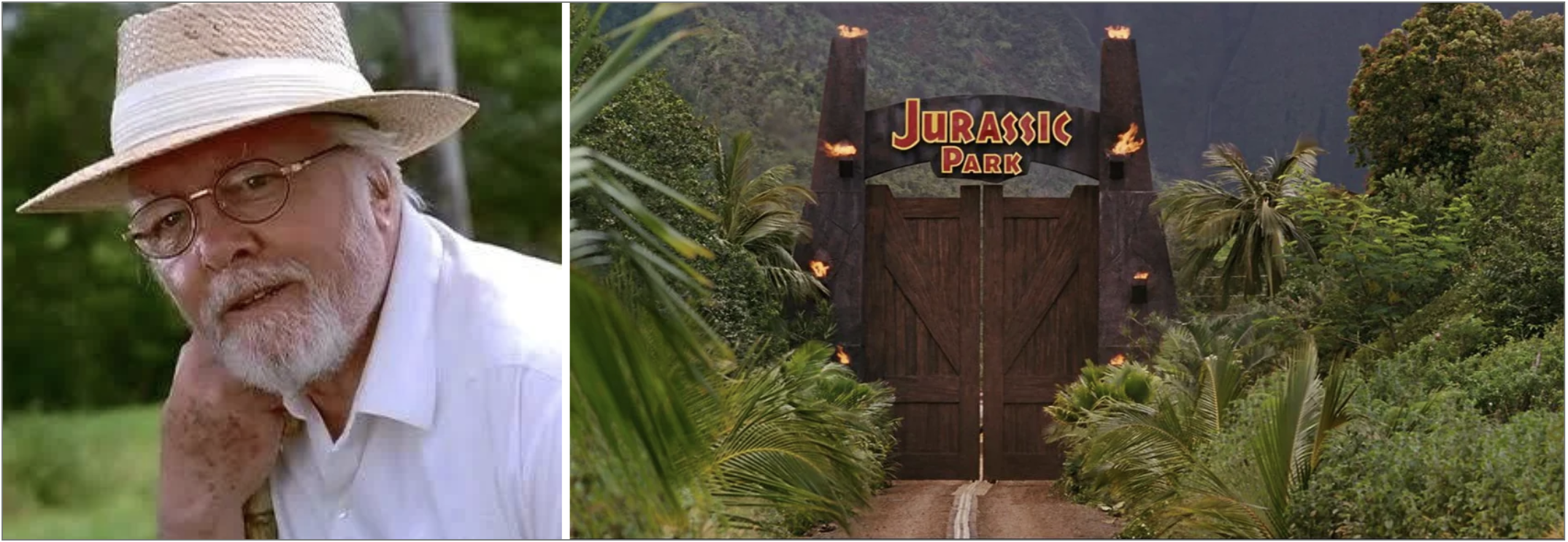
“Welcome to Jurassic Park.”
All the examples above share a common logic. They use science fiction (sf) as a multiplier: rather than just saying "this proposal is too broad" or "yikes, the microbes might get out," they pair scientific reasoning with the graphic, gory outcome of Hammond's vision.
That JP turns up in such a wide array of research fields shouldn't be surprising. Because sf isn't really about the science, and Jurassic Park isn't really about the dinosaurs.
"Science fiction is not predictive," sf author Ursula K. Le Guin once wrote; "it is descriptive." She meant that sf isn't about predicting the future (how will we clone dinosaurs?)—but about what the futures we imagine say about us. Now. In our world. Yes, JP makes a strong case for regulation in genetic engineering. But you could take out the dinosaurs altogether and still have a searing narrative of an aging visionary bending nature to his will with tragic consequences. It's not about the dinosaurs; it's about intellectual overreach and failure.
And because sf is descriptive more than predictive, it has a particular role as a testing ground for the social and cultural implications of science. In this it is allied with the proposals of Donlan and Thomas. It asks "what if?" without worrying overmuch about the technical answers.
Indeed, science and science fiction share a common speculative impulse. "What if?" underlies scientific reasoning—it's the basis of hypothesis. And "what if?" underlies sf—it defines the terms by which we can explore the human and ethical consequences of science.
What if we built a park with real dinosaurs?
What if we could save species by moving them geographically?
Does this raptor need a taller fence, do you think?
Can we re-wild North America?
Donlan and Thomas wrote their proposals in this same speculative mode. As far as I’m concerned, yes, there's science fiction in that. But let's not be too quick to reject visions just because they are science fiction-y. The question shouldn't be "are scientists allowed to craft far-reaching visions?" Instead it should be "what can those visions show us, and how can we put them to work responsibly?"
The practical lesson in all of this: activating a sf critique like Crichton's is a power move. Even a passing allusion can make people think of the possible outcomes of their current trajectory. Whether you're talking about clinical practice or microorganisms or something else, dropping in a JP reference says "are you sure you want to let the raptors out?" It's a metaphor, and a powerful one.
My advice: use sf references freely, but thoughtfully. Like I said last time, make sure the story you're referencing is organically connected to your research. Don't make it so far-fetched that it feels random.
Ask yourself, "what am I cautioning against?" Sf can absolutely sharpen critiques of current practice, especially if you're discussing risks.
And if you're using an sf reference to push back on a thought experiment of some sort, make sure you're not weaponizing caution against imagination (or scientific speculation) itself. If a proposal makes you think of a sf story because it feels too bold or speculative, stop and ask: is the speculation here perhaps the point? Am I rejecting the idea or just the ambition?
When well placed, sf references enliven, entertain, and amplify. So use them freely to magnify your message. Use them to help you describe the real risks of human error and oversight. A few words alluding to science fictional insights can, in an instant, connect your carefully worded, narrowly focused, scientifically validated work to something bigger: to what it means.
“You bred raptors?”
Special thanks is due to the students in my winter 2026 “Writing Science course,” who generously put up with my obsession while helping sharpen my thinking on Jurassic Park and its various cultural manifestations.
____
*In Crichton's novel, Malcolm's chaos theory warnings are interspersed throughout the narrative, accompanied by illustrations of the iconic dragon curve fractal. These pages foreshadow the park’s inevitable collapse. Katerndahl recreates this structure in his article's organization, by using such quotes as the titles of his subsections. Brilliant!
**Though to be fair, let's give Katerndahl the advantage. As my students point out, Malcolm could have spoken up to authorities before his vacation to JP. He didn't.