Life Finds a Way (Into Scientific Writing): Jurassic Park, part 1
What is it about Jurassic Park?
Michael Crichton's genetic engineering thriller dropped nearly 35 years ago, in November 1990, and the first film followed in the summer of 1993. Since then, the franchise has sprawled into 6 more films (and counting), amusement park rides, toys, video games, and a merchandising empire that have kept this story about resurrected dinosaurs embedded in our cultural imagination across generations.
It's not surprising, then, that Jurassic Park (JP) references show up in the scientific literature as well. Today on the blog, I'll take you through some of the ways in which this always-relevant franchise is put to work to enliven scientific writing through allusions, comparisons, and calls to action.
Science fiction references turn up with some frequency in research writing, and JP has historically been among the most frequently cited franchises. It shows up in paleontology, conservation biology, and ancient DNA research, as one might expect. But I've also spotted JP references in the literature on microbial evolution, clinical research, bioethics, respiratory physiology, family psychology, and even software engineering.
How to make sense of this particular science fiction franchise's enduring appeal within science? Are scientists simply absorbing and recycling storylines from our ambient culture? Or are they tapping into something deeper when they call on this potent, deeply entrenched storyline? I suspect it's the latter. Because the thing is, sf references are far-reaching and powerful. They call forth whole worlds of possibility and connect to a vast, shared cultural imagination.
Those worlds of possibility are often summoned as cautionary tales. JP references often amount to warnings of "unintended consequences" when science is taken too far. Indeed, Crichton's books are universally scornful of the scientific establishment—or rather, the disaster that can result from human error in science. The plot of the original novel can be summarized like this: oh! the dinosaurs got out; probably should have seen that coming. Certainly, many JP references in the scientific literature point in some way to this sentiment. But that's for the next post.
Today: let's think about how scientists invoke the story to make claims about possibility—about what's inevitable, what's achievable, and what needs to happen.
JP is perfectly situated for such claims: Does anything say "the possibilities of science are endless" quite like watching that helicopter soar over the ocean on its way to the park, catching a first glimpse of the dinosaurs over John Williams's iconic score?
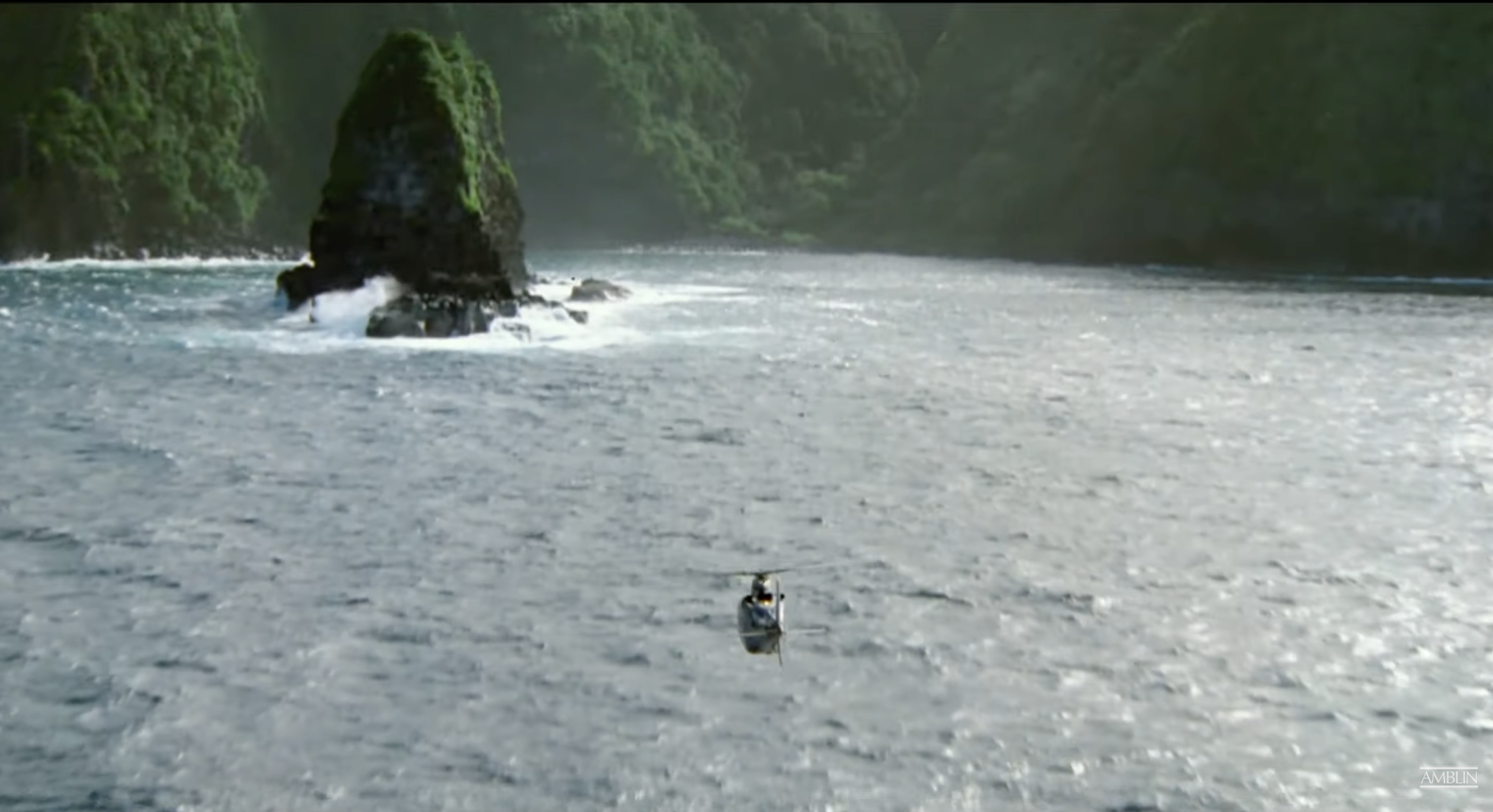
Stephen King, in his obituary for Crichton, wrote that "he made you believe that cloning dinosaurs wasn't just over the horizon but possible tomorrow. Maybe today." He's right. And even though we know the cloning was a bad idea—even though we know this story and we know the raptors are going to get out—the wonder sweeps us up all the same.
In the examples below, I'll show you how much work a simple science fictional reference can do in scientific writing. Mentions of JP (the novel, film, or general phenomenon) are multipliers, adding a rhetorical punch that helps authors convey why and how their work matters, both now and for the future.
For instance, consider an article from Frontiers in Psychologytitled "Life Finds a Way: Young Adults With Lesbian Mothers Reflect on Their Childhood Prior to Legal Recognition of Same-Sex Parents in Sweden" (Malmquist et al.). Here the story supports an argument for reproductive equity. The authors explain in the abstract:
The strapline "life finds a way," from the classic movie Jurassic Park, referred to how the all-female dinosaurs in a theme park had been able to reproduce, despite the laws of nature. Similarly, the participants in the present study described how their lesbian mothers had shown that "life finds a way," when having children and forming a family, prior to the legal recognition of same-sex parents in Sweden.
The film is mentioned in support of queer family-building among mothers who "[found] pathways to have and raise children despite huge obstacles presented by the laws of society." The film's futuristic science is transposed into the recent human past: lesbian mothers have found a way with all the determination of Crichton's dinosaurs. Invoking JP affirms parenting as an instinct and inevitability, shifting the perspective from restriction to possibility. In other words: these mothers made the dream of queer family-making real even before it could be legally recognized.
Elsewhere in the literature, JP references tend to present the story as reflecting the latent potential of science itself. These usages say something about what science can be or should become.
The connection is readily apparent in papers that report on techniques similar to those used in JP. Consider this pair of studies that both situate themselves within the story's vision of extracting dinosaur DNA from amber-embedded insects:
Vršanský et al., "Jurassic Park approached: a coccid from Kimmeridgian cheirolepidiacean Aintourine Lebanese amber." National Science Review 2025.
Smejkal et al., "Revisiting Jurassic Park: The Isolation of Proteins from Amber Encapsulated Organisms Millions of Years Old." Sample Preparation in Biological Mass Spectrometry 2011.
Each establishes JP as a rhetorical foundation of its research. Smejkal et al. write that Jurassic Park proposed the recovery of dinosaur DNA from the alimentary tracts of hematophagous insects preserved for millions of years in amber" before explaining how their work improves upon this premise. They continue, "Though Crichton's work was purely fictional, amber inclusions have shown remarkable preservation of organisms at the tissue and cellular levels..." Their research is thus positioned as responding to Crichton's insight.
Vršanský et al. frame their study as answering some of the problems intrinsic JP's science. Their introduction begins, "The science fiction film Jurassic Park influenced a whole generation of researchers, although having three major inconstancies related with ‘life in amber.'" Those inconstancies become the basis of their paper, which corrects Crichton's imaginary science even as it reports on something that JP fans would find exciting: "the first known fossil organism from Jurassic amber."
Both sets of authors, then, frame their research as answering to Crichton's vision: fictional science appears as something to be tested, improved upon, and made real. That sense of fiction-come-true is captured in the two titles, which present JP as a physical location that is "revisted" and "approached" through real-world science.
Even in fields unrelated to the science of JP, the film shows up as a means of arguing for how science itself can or should develop. Such references typically note how the novel and film created a surging interest in paleontology, inspiring careers and increasing research funding. For instance, look at this article in Global Bioethics from 2025, titled "One health's 'Jurassic Park moment': tempered reasons for optimism."
The opinion article diagnoses the One Health initiative—which calls for extending medicine's reach to include animal, ecosystem, and planetary health—with a failure to live up to its promises. The authors note that medicine has largely continued its traditional focus on human health and call on the power of fiction to help it correct course, advocating for "a shift in imagination from people to planet."
JP is their model, and they argue that One Health "is just waiting for its Jurassic Park moment"—a moment that could "[change] the momentum and direction of an entire discipline." While they don't specify what sort of fiction might achieve this objective, they hold the real-world example of JP as inspiration: the franchise is called in to exemplify how fiction can fuel the imaginative engine of scientific advancement.
Or, said another way, the vast science fictional imaginary of an entire culture can drive science in the real world—and all we need to do is activate it.
Science fiction references in the literature are deceptive. On the surface they may look glancing or irreverent, but even short mentions are doing real rhetorical work. In each of the cases named above—in papers on same-sex parenting, amber research, and global health—Crichton's story is used to support claims about the paper's relevance to society or the moral implications of the issues being investigated.
Sometimes those claims are in a marveling register ("just LOOK at what science can do!") and sometimes they feel more urgent ("we need resources, now!"). But all are using fiction to describe imagined futures that need to be made real, built, and supported.
And so a scientist invoking JP isn't doing so just to sound cool, or just because they've absorbed our cultural obsession with this narrative. Science fiction references may be serious or unserious, but they are never neutral: they're activating decades of cultural imagination and conversation about what science is, what it can be, what it should be. Whole universes of possibility are entailed in even the simplest passing references to fiction.
A few words on how to use science fiction in science: cautiously, freely, responsibly. If your work constantly makes you think about something from science fiction, or if people are constantly commenting on how what you do reminds them of something science fictional, take note of that. There's power in such connections, should you choose to deploy it.
Of course, any such references should emerge naturally and should connect in some way to the subject of the research; references built on tenuous connections may distract more than help.
But if you see a connection between your work and science fiction—to create a sense of possibility, to evoke a sense of wonder in what science can uniquely produce, to argue for a different way of seeing, or to open readers' imaginations to what your work could mean? Boldly go; fire away.
Up next on the blog: the flip side of the coin. Jurassic Park? What a terrible idea.
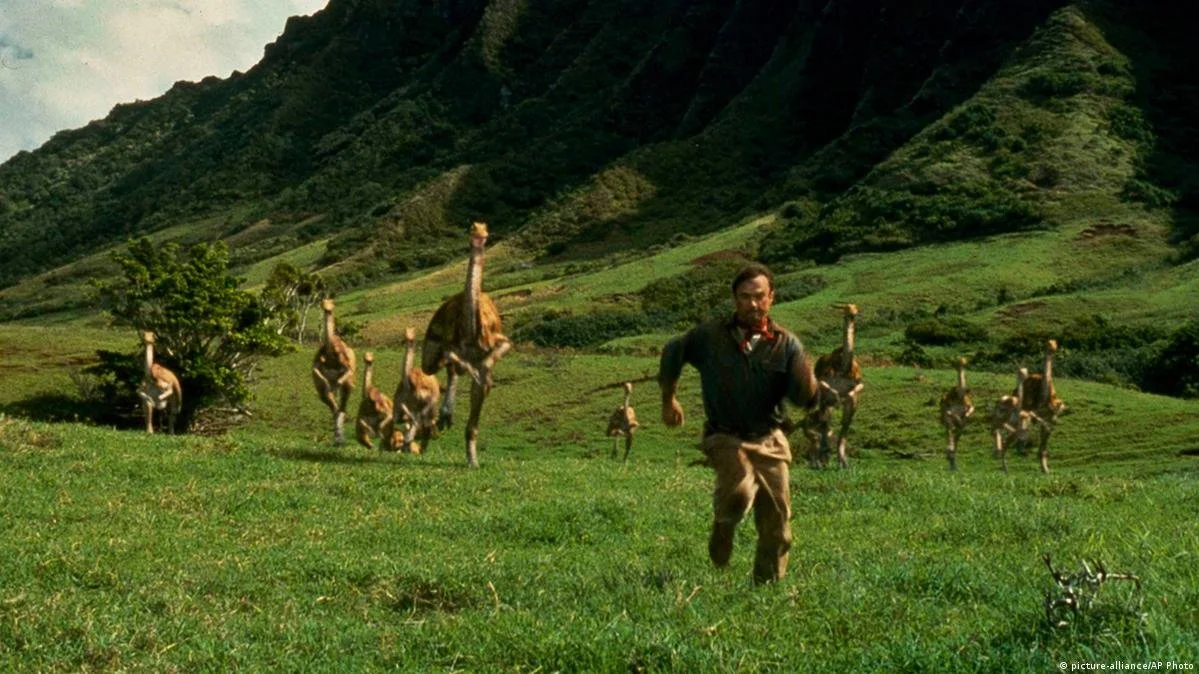
Yes, Dr. Grant can outrun the Gallimimus stampede.
Special thanks is due to the students in my winter 2026 “Writing Science course,” who generously put up with my obsession while helping sharpen my thinking on Jurassic Park and its various cultural manifestations.