Devil in the details: A catchphrase title that works
The scientific literature can feel like a sea of titles. Most flow right on by me, but this one from a research group at Northern Arizona University made me stop:
Dancing with the Dust Devil: Examining the Lung Mycobiome of Sonoran Desert Wild Mammals and the Effect of Coccidioides Presence (DOI)
Not because the research sounds cool (which it does) but because of that opening phrase. Dancing with dust devils? That's a whole mood.
Let's take a look at whether, how, and why it works.
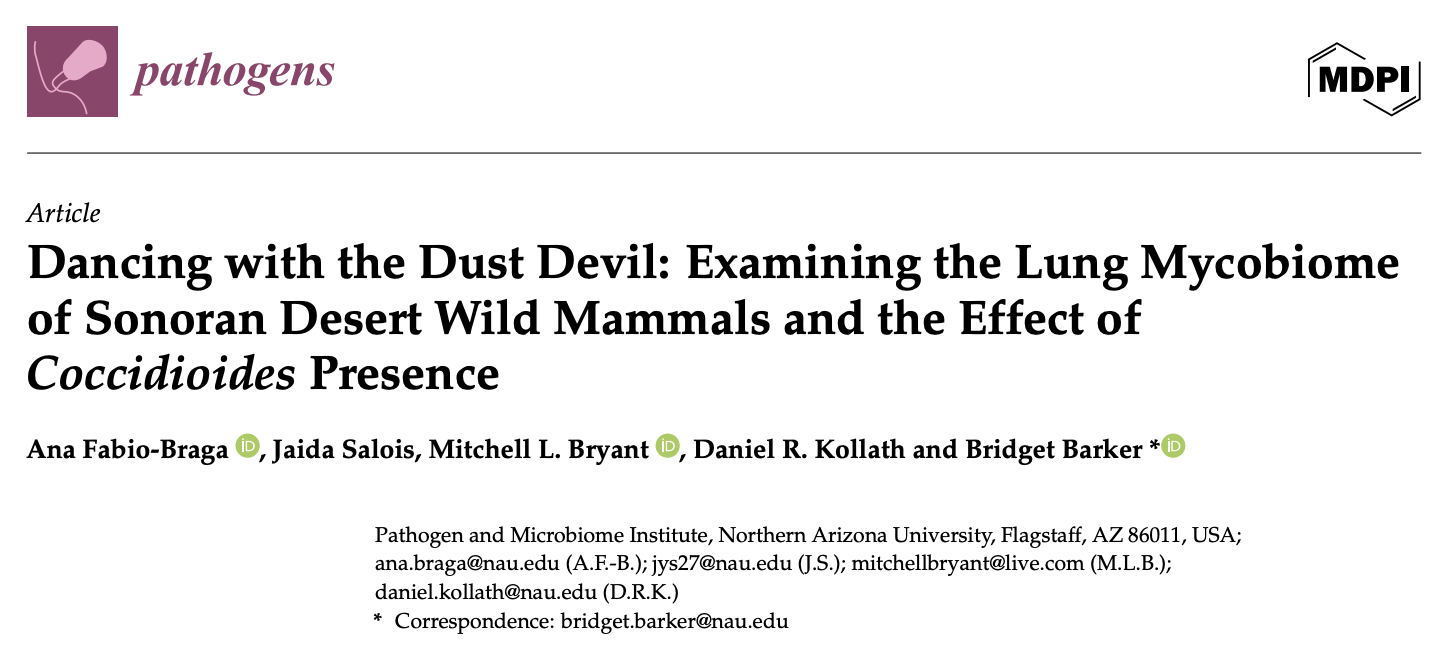
"Dancing with the Dust Devil: Examining the Lung Mycobiome of Sonoran Desert Wild Mammals and the Effect of Coccidioides Presence" by Ana Fabio-Braga et al.
Two-part titles like this are common enough in research publishing, and for good reason: they're useful. They establish a paper's topic and conclusions in an immediate, compact way. They typically share a familiar structure, moving from broad to specific.
Main idea: Details.
Big thing: Little thing.
For instance ...
Host genetics shape microbiome composition: Insights from a large‐scale mouse panel. This one leads with a claim that establishes the paper's broadest implications (host genetics, microbiome). The subtitle follows up with the model system (mice) and a nod to study design (large-scale panel). Broad: specific.
Regulatory T cell dynamics: Spatial transcriptomics in autoimmune disease models. This one opens with a topic (T cell dynamics) rather than a claim, followed by the details (transcriptomics, disease models). Again, it's broad: specific. What they researched: how they did it.
These titles do a lot of work. They're functional, laying out the paper's scope concisely and straightforwardly.
But in the case of "Dancing with the dust devil," that opening phrase is a flourish. A grace note. A little something extra. And I love it.
Fabio-Braga et al.'s title is one of many that incorporate a familiar catchphrase but rewrite it slightly or use it in an unexpected way. For instance:
Small talk. Cell-to-cell communication in bacteria and
Fantastic yeasts and where to find them: the hidden diversity of dimorphic fungal pathogens.
These opening phrases do relate to the topic to be discussed but are less directly connected to their subtitles, and less essential: "Regulatory T cell dynamics" brings a level of specificity that "Small talk" doesn't.
Titles that lead with figurative language, buzzwords, or catchphrases come up for debate from time to time. At issue: do they increase engagement and, if so, is it substantive engagement?
Research into the use of humor in titles can give us a clue. A 2008 study by Sagi & Yechiam noticed a detrimental effect, finding that "articles with highly amusing titles (2 standard deviations above average) received fewer citations." But other groups have unable to replicate this finding. In 2023, Heard et al. noted that the 2008 study had not corrected for the relative importance of the papers selected. In their own study 2,439 ecology and evolution paper titles, they corrected for the fact that authors tend to assign funny titles to papers they deem less important – and found that humor has a significantly positive impact on citation rate. Their results, they conclude, mean that "scientists can use titles creatively, even inserting touches of humour, without fear of their work ending up in undeserved obscurity."
So humor won't hurt, and it may help. In general, the consensus on titles is that they should thoughtful, well-crafted, and possibly tripartite. The main thing is to make sure they accurately reflect your work. Catchphrase titles, it seems, might work similarly: they could help your work get noticed, downloaded, cited.
Flashy titles not your thing? Or feel that, as Heard et al. suggest, they may not suit the seriousness of your more-important work? That's fine! Don't use them. That's a solid and reasonable decision.
Leaning toward a funny title? Just don't make it gratuitous or irritating. Don't try too hard or end up with a mismatch (e.g., "Checkmate: Examining the Lung Mycobiome of Sonoran Desert Wild Mammals..."). But do have a little fun. Go ahead and set a little mood. Be like Fabio-Braga et al.
Back to our dust devils.
Is this title something more than decorative? It's certainly built around a catchphrase: to "dance with the devil" usually means to invite risk, to do something immoral or destructive (see Demi Lovato, for whom the devil is substance abuse: "I was dancing with the devil / Out of control ... / Playing with the enemy / Gambling with my soul").
Does this study document something immoral happening? Well, no. "Doing something risky involving dust: Examining the Lung Mycobiome..." doesn't quite work.
Any actual dancing, or actual devils? Nope.
Any devil-related animals, Tasmanian or otherwise? Also nope.
Metaphorically, though ...
The study tracks the presence and absence of Coccidioides, the fungus that causes Valley fever and is endemic in the southwestern US. The authors note that "17,612 cases of coccidioidomycosis were reported in the United States in 2022," mostly in Arizona and California, and that the lifetime cost of coccidioidomycosis just for the cases diagnosed in Arizona in 2019 would be $736 million. Indeed, the disease and its medical and financial burdens are the justifications on which the study rests: Fabio-Braga et al. are after all publishing in the journal pathogens.
So the devil in the dust ... is the fungus.
The authors found that Coccidioides appears to inhabit wild mammals without causing disease. This means those animals could be important reservoirs for environmental Coccidioides, which also lives in the soil. This, to me, means the title does capture an appropriate sense of risk, specifically, physiological and microbiological risk. Be careful in the desert, you might meet a devil there.
The word "dancing" works here as well, on a more figurative level. Host-mycobiome interactions are dynamic and constantly changing: organisms come and go, and they interact with their hosts in complex ways. This too is a central justification for the study, and the paper opens in just this way: "While there is an emerging interest in lung mycobiome of wild animals, we still have a limited understanding of the complex host-mycobiome dynamics." Dancing, like mycobiomes, is dynamic. The metaphor holds.
Who's doing the dancing? Is it the researchers (or more accurately, the Arizona Game and Fish Department workers who collected the samples)? The squirrels, rodents, and jackrabbits under study, who were running around the desert with their endozoan fungi? Or the fungi themselves, which are constantly moving in and out of soil, animals, humans? I don't think it matters much. It can be all of them: metaphors are expansive and powerful.
To reduce the title down to its literal core might result in something like this: Desert germs that can cause nasty infections are always moving around: Examining the Lung Mycobiome of Sonoran Desert Wild Mammals and the Effect of Coccidioides Presence. Guess what? That's functional. Concept: Details.
But the metaphorical version is much better 🙂
There is yet another way in which this title nails it: by evoking a particular image uniquely bound up in the landscape of the study site. Specifically ...
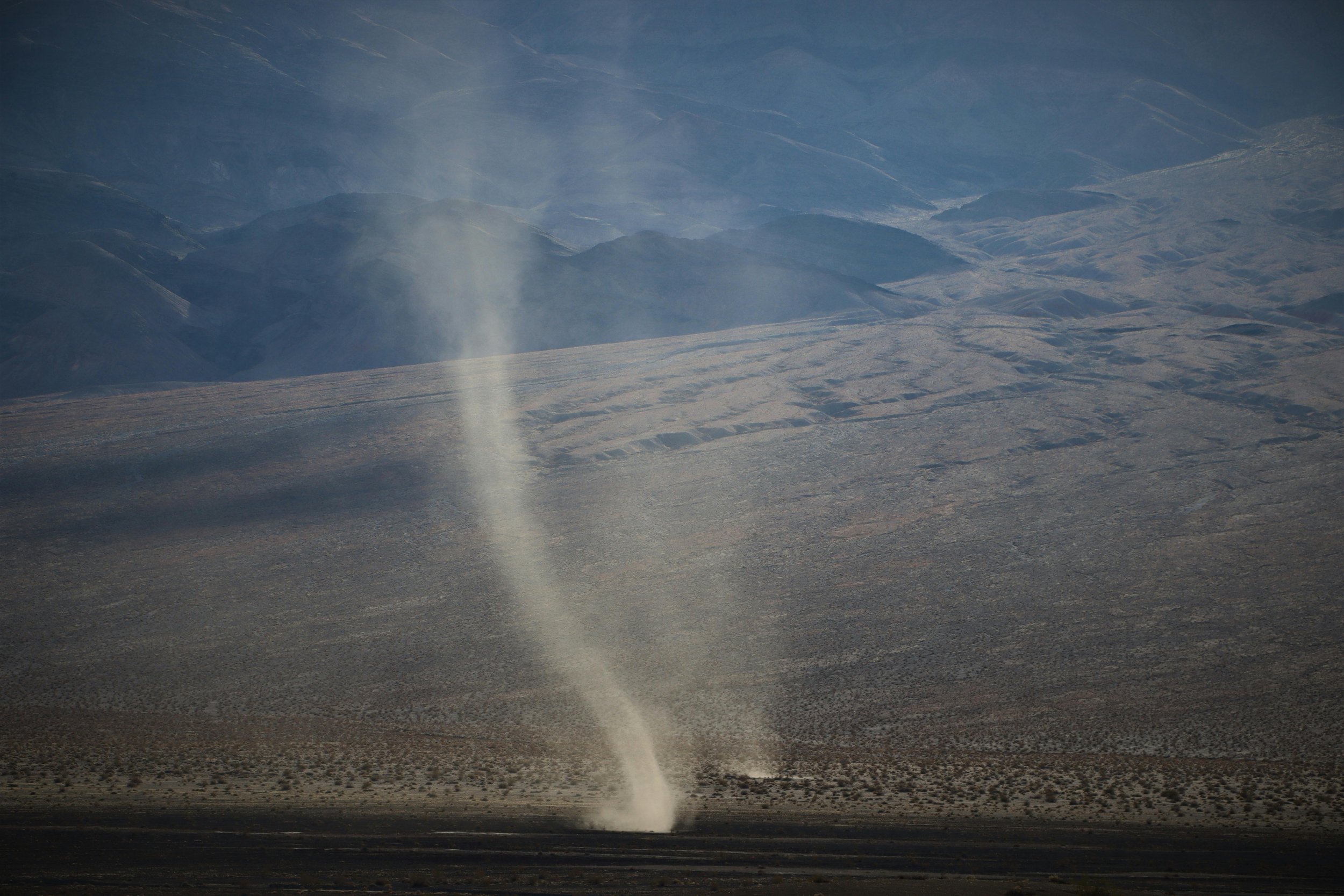
Dust devil. Photo by Thilani Ratheep.
... dust devils: soil and sand – and maybe Coccidioides – that spin up into the sky when the desert's hot. Iconic features of the Southwestern desert landscape, especially in the Phoenix and Tucson areas, where the study's samples were collected. The "devil" of the paper's title thus references not only the sense of risk (dancing with the devil) and motion (dancing) but also the landscape of the study sites themselves.
Scientists don't have to choose between precision and personality. If a bit of humor suits you and jives with the paper you're writing, use it!
Fabio-Braga's title is anything but superficial. It signals the topic and evokes a sense of motion consistent with the study's theoretical basis. It captures the sense of microbiological risk on which the study's foundation rests. It nods to the research site itself and places the reader right in the middle of the scene: a desert landscape marked by swirling dust (and fungus).
In other words, the title is a flourish but not only a flourish. That modified catchphrase that caught my eye is in fact internally consistent with the logic of the paper as a whole.
It's smart. It's incisive. It works.